

Mathematics Sets Questions And Answers Pdf
If A = {x, y, z}, then the number of subsets in powerset of A is
- 6
- 8
- 7
- 9
Answer (Detailed Solution Below)
Option 2 : 8
Stay updated with the Mathematics questions & answers with Testbook. Know more about Sets and ace the concept of Set Theory and types of Sets.
Concept:
The power set (or powerset ) of a Set A is defined as the set of all subsets of the Set A including the Set itself and the null or empty set .
Calculations:
Given, A = {x, y, z}.
The power set (or powerset ) of a Set A is defined as the set of all subsets of the Set A including the Set itself and the null or empty set .
Powerset of A = {\(\rm \phi\),x, y, z, {x, y}, {y, z}, {x, z},{x, y, z}}.
Hence, the number of subsets in powerset of A is 8.
Let S be a set of all distinct numbers of the form \(\frac{{\rm{p}}}{{\rm{q}}}\), where p, q ∈ {1, 2, 3, 4, 5, 6}. What is the the cardinality of the set S?
- 21
- 23
- 32
- 36
Answer (Detailed Solution Below)
Option 2 : 23
Calculation:
Given: We have to form all distinct numbers of the form\(\frac{{\rm{p}}}{{\rm{q}}}\)
As 1/2, 2/4, 3/6 are same and 1/1, 2/2, 3/3...6/6 are same.
We will find only co-prime numbers.
| p | q | Total elements in S |
| 1 | {1, 2, 3, 4, 5, 6} | 6 |
| 2 | {1, 3, 5} | 3 |
| 3 | {1, 2, 4, 5} | 4 |
| 4 | {1, 3, 5} | 3 |
| 5 | {1, 2, 3, 4, 6} | 5 |
| 6 | {1, 5} | 2 |
∴ Cardinality of set S = 6 + 3 + 4 + 3 + 5 + 2 = 23
Suppose A and B are two sets in the same broad set. Then, A - B =
- A ∩ B
- Only B
- Only A
- A' ∩ B
Answer (Detailed Solution Below)
Option 3 : Only A
The given two sets - A and B, can be shown as follows:
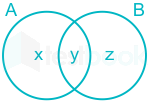
In the Venn Diagram:
x = Elements which are in set A only,
y = Elements which are in both - set A and set B,
z = Elements which are in set B only.
We need to obtain A – B
From the Venn Diagram, it is clear that:
⇒ A – B = (x + y) – y = x
∴ (A – B) = only A
Consider the following statements:
1. The null set is a subset of every set.
2. Every set is a subset of itself.
3. If a set has 10 elements, then its power set will have 1024 elements.
Which of the above statements are correct?
- 1 and 2 only
- 2 and 3 only
- 1 and 3 only
- 1, 2 and 3
Answer (Detailed Solution Below)
Option 4 : 1, 2 and 3
Concept:
1. The null set is a subset of every set. (ϕ ⊆ A)
2. Every set is a subset of itself. (A ⊆ A)
3. The number of subsets of a set with n elements is 2n.
Explanation:
1. The null set is a subset of every set - The intersection of two sets is a subset of each of the original sets.
So if {} is the empty set and A is any set then {} intersect A is {} which means {} is a subset of A and {} is a subset of {}.
You can prove it by contradiction. Let's say that you have the empty set {} and a set A.
2.Every set is a subset of itself. (A ⊆ A)
3. If n = 10 then 210 = 1024
So, all three statements are true.
The number of element in the power set P(S) of set S = {2, {1, 4}} is ?
- 2
- 4
- 8
- 10
Answer (Detailed Solution Below)
Option 2 : 4
Concept:
The number of elements in the power set of any set A is 2 n where n is the number of elements of the set A.
Calculation:
Given, set S = {2, {1, 4}},
Number of elements in set S = 2
\(\therefore \)The number of element in the power set P(S) = 22 = 4
Hence, option (2) is correct.
Let A = {1, 2, 3, 4, 5, 6, 7, 8, 9, 10}. Then the number of subsets of A containing exactly two elements is
- 20
- 40
- 45
- 90
Answer (Detailed Solution Below)
Option 3 : 45
Concept:
Combination: Selecting r objects from given n objects.
- The number of selections of r objects from the given n objects is denoted by\({{\rm{\;}}^{\rm{n}}}{{\rm{C}}_{\rm{r}}}{\rm{\;}}\)
- \({{\rm{\;}}^{\rm{n}}}{{\rm{C}}_{\rm{r}}}{\rm{}} = {\rm{}}\frac{{{\rm{n}}!}}{{{\rm{r}}!\left( {{\rm{n\;}} - {\rm{\;r}}} \right)!}}\)
Note: Use combinations if a problem calls for the number of ways of selecting objects.
Calculation:
Number of elements in A = 10
Number of subsets of A containing exactly two elements = Number of ways we can select 2 elements from 10 elements
⇒ Number of ways we can select 2 elements from 10 elements = 10C2 = 45
∴ Number of subsets of A containing exactly two elements = 45
If A = { x : x is a multiple of 3} and B = (x : x is a multiple of 4} and C = {x : x is a multiple of 12}, then which one of the following is a null set?
- (A \ B) ∪ C
- (A \ B) \ C
- (A ∩ B)∩ C
- (A ∩ B) \ C
Answer (Detailed Solution Below)
Option 4 : (A ∩ B) \ C
Concept:
- Null set is the set that does not contain anything.
- In mathematical sets, the null set, also called the empty set,
- It is symbolized or { }.
Calculation:
Given:
A = {x : x is a multiple of 3}
∴ A = {3, 6, 9, 12, 15, 18, 24…}
B = {x : x is a multiple of 4}
∴ B = {4, 8, 12, 16, 20, 24, 28, 32 ...}
C = {x : x is a multiple of 12}
∴ C = {12, 24, 36, 48, 60, 72, 84, 96 ...}
Now,
A∩B = {12, 24 ...} = C
∴ (A∩B) \ C = { } = Null set
Let P = {θ∶ sin θ - cos θ = √2 cos θ} and Q = {θ∶ sin θ + cos θ = √2 sin θ} be two sets. Then:
- P ⊂ Q and Q - P ≠ 0.
- P ⊄ Q.
- Q ⊄ P.
- P = Q.
Answer (Detailed Solution Below)
Option 4 : P = Q.
Concept:
- \(\rm \tan\theta=\frac{\sin\theta}{\cos\theta}\).
Calculation:
Consider the relation in the set P = {θ∶ sin θ - cos θ = √2 cos θ}.
sin θ - cos θ = √2 cos θ
Dividing both sides by cos θ, we get:
tan θ - 1 = √2
⇒ tan θ = √2 + 1
∴ P = {θ: tan θ = √2 + 1} ... (1)
Consider the relation in the set Q = {θ∶ sin θ + cos θ = √2 sin θ}.
sin θ + cos θ = √2 sin θ
Dividing both sides by cos θ, we get:
tan θ + 1 = √2 tan θ
⇒\(\rm \tan\theta = \frac{1}{\sqrt2 - 1}=\frac{1}{\sqrt2 - 1}\times\frac{\sqrt2+1}{\sqrt2 + 1}=\frac{\sqrt2+1}{2 - 1}=\sqrt2+1\)
∴ Q = {θ: tan θ = √2 + 1} ... (2)
Comparing equations (1) and (2), we have:
P = Q.
If A and B are non-empty subsets of a set C, then A ∪ (A ∩ B) is equal to
- A ∩ B
- A ∪ B
- A
- B
Answer (Detailed Solution Below)
Option 3 : A
Calculation:
According to the question,
A is a non-empty subset = A⊆ C
B is a non-empty subset = B⊆ C
By Distributive property,
A ∪ (A ∩ B) = (A ⋃ A) ∩(A ⋃ B)= A
If A = {x, y, z}, then the number of subsets in powerset of A is
- 6
- 8
- 7
- 9
- None of these
Answer (Detailed Solution Below)
Option 2 : 8
Concept:
The power set (or powerset ) of a Set A is defined as the set of all subsets of the Set A including the Set itself and the null or empty set .
Calculations:
Given, A = {x, y, z}.
The power set (or powerset ) of a Set A is defined as the set of all subsets of the Set A including the Set itself and the null or empty set .
Powerset of A = {\(\rm \phi\),x, y, z, {x, y}, {y, z}, {x, z},{x, y, z}}.
Hence, the number of subsets in powerset of A is 8.
The set x = {n; 2n2 + 7n - 15 < 0} is equal to-
- -3/2 < x < 5
- 3/2 < x < 5
- -5 < x < -3/2
- -5 < x < 3/2
Answer (Detailed Solution Below)
Option 4 : -5 < x < 3/2
GIVEN:
x = {n; 2n2 + 7n - 15 < 0}
CONCEPT:
Concept of sets and relation.
FORMULA USED:
No formula
CALCULATION:
x = {n; 2n2 + 7n - 15 < 0}
⇒ 2n2 + 7n - 15 < 0
⇒ 2n2 + 10n - 3n - 15 < 0
⇒ 2n(n + 5) - 3(n + 5) < 0
⇒ (n + 5)(2n - 3) < 0
⇒ n = (-5, 3/2)
-5 < x < 3/2
In every (n + 1) - - elementic subset of the set (1, 2, 3, .......2n) which of the following is correct:
- There exist at least two natural numbers which are prime to each other
- exist at least three natural umber which are prime to each other
- There exist no consecutive natural number
- There exist more than two natural numbers which are prime to each other
Answer (Detailed Solution Below)
Option 1 : There exist at least two natural numbers which are prime to each other
Concept :
The Pigeonhole Principle: Let there be n boxes and (n + 1) objects. Then, under any assignment of objects to the boxes, there will always be a box with more than one object in it. This can be reworded as, if m pigeons occupy n pigeonholes, where m > n, then there is at least one pigeonhole with two or more pigeons in it.
Calculation :
We divide the set into n classes {1, 2}, {3, 4},......{2n - 1, 2n}.
By the pigeonhole principle, given n +1 elements at least two of them will be in the same case {2k - 1, 2k} (1 ≤ k ≤ n). But 2k - 1 and 2k are relatively prime because their difference is 1.
For any set A, (A')' is equal to ______.
- AA'
- A'
- A
- ϕ
Answer (Detailed Solution Below)
Option 3 : A
Given:
The given set is A.
Formula:
If A is a set and U is a universal set.
Then complement of set A = U – A.
Calculation:
Let us consider a set A and a universal set U.
If A = {1, 4, 7, 9) and U = {1, 2, 3, 4, 5, 6, 7, 8, 9, 10, 11}
Then the complement of set A = U – A
Let A' represent the complement of set A
A' = U – A
⇒ A' = {1, 2, 3, 4, 5, 6, 7, 8, 9, 10, 11} - {1, 4, 7, 9)
⇒ A' = {2, 3, 5, 6, 8, 10, 11}
⇒ (A')' = U – A'
⇒ (A')' = {1, 2, 3, 4, 5, 6, 7, 8, 9, 10, 11} - {2, 3, 5, 6, 8, 10, 11}
⇒ (A')' = {1, 4, 7, 9}
We can say that complement of complement of a set A equals to the set A.
∴ Option (3) is the correct answer.
If A is an open set and B is a closed set, then B - A is
- Open set
- Closed set
- Both open and closed set
- None of these
Answer (Detailed Solution Below)
Option 2 : Closed set
Concept:
The open set has no boundary whether the closed set has a boundary.
If A is an open set and B is a closed set then,
B - A = closed set - open set
⇒ closed set
The subsets of the set {0} will be
- ϕ
- ϕ, {0}
- {0}
- ϕ, {0}, {0, ϕ}
Answer (Detailed Solution Below)
Option 2 : ϕ, {0}
Concept:
A set with one element has 2 subsets i.e. The null set and itself
∴ {0} = ϕ, {0}
If A is a subset of B and B is a subset of C, then the cardinality of A ∪ B ∪ C is equal to:
- Cardinality of C.
- Cardinality of B.
- Cardinality of A.
- None of the above.
Answer (Detailed Solution Below)
Option 1 : Cardinality of C.
Concept:
- The cardinality of a set A is the measure of the "number of elements" of the set. It is denoted by n(A).
For example, a set containing 3 elements has a cardinality of 3. - If A ⊂ B, then A∪ B = B.
Calculations:
Since, A ⊂ B and B ⊂ C, therefore A ∪ B ∪ C = C.
⇒ n(A ∪ B ∪ C) = n(C).
∴ The cardinality (number of elements) of A ∪ B ∪ C is equal to cardinality (number of elements) of C.
Which of the following is a null set?
- {x : |x| < 1, x ∈ N}
- {x : |x| = 5, x ∈ N}
- {x : x2 + 2x + 1 = 0, x ∈ R}
- {x : x2 = 1, x ∈ Z}
Answer (Detailed Solution Below)
Option 1 : {x : |x| < 1, x ∈ N}
CONCEPT :
Null Set: A set which does not contain any element is called a null set. It is denoted by ϕ or {}.
CALCULATION :
Option A: {x : |x| < 1, x ∈ N}
As we know that there is no x ∈ N such that |x| < 1
So, {x : |x| < 1, x ∈ N} is a null set
Option B: {x : |x| = 5, x ∈ N}
As we know that, |5| = 5 and 5 ∈ N
⇒ 5 ∈ {x : |x| = 5, x ∈ N}
So, {x : |x| = 5, x ∈ N} is not a null set.
Option C: {x : x2 + 2x + 1 = 0, x ∈ R}
⇒ x2 + 2x + 1 = 0
⇒ x = - 1 ∈ R
⇒ - 1 ∈ {x : x2 + 2x + 1 = 0, x ∈ R}
So, {x : x2 + 2x + 1 = 0, x ∈ R} is not a null set.
Option D: {x : x2 = 1, x ∈ Z}
⇒ x2 = 1
⇒ x = ± 1 ∈ Z
⇒ ± 1 ∈ {x : x2 = 1, x ∈ Z}
So, {x : x2 = 1, x ∈ Z} is not a null set.
Hence, option A is the correct answer.
If A = {x ∶ x is a letter in word BELOW}, B = {x ∶ x is a letter in word WOOL} and C = A – B, then the number of subsets of C is
- 1
- 2
- 3
- 4
Answer (Detailed Solution Below)
Option 4 : 4
Given:
A = {BELOW}, B = {WOOL}
Concept used:
If a set has "n" elements, then the number of subset of the given set is 2n
Calculation:
⇒ C = A – B
⇒ C = {B, E} taking out the common letters.
The subsets of C = 22 = 4
∴ The number of subsets of C is 4
If S = {x : x2 + 1 = 0, x is real}, then S is
- {-1}
- {0}
- {1}
- an empty set
Answer (Detailed Solution Below)
Option 4 : an empty set
Concept:
- If a set does not contain any element than it is called empty set.
- i = \(\sqrt { - 1}\)
Calculation:
Given that,
S = {x : x2 + 1 = 0, x is real}
⇒ x2 + 1 = 0
⇒ x2 = - 1
⇒ x = ±√(-1)
⇒ x = ± i imaginary
But given that set only contain real value of x but after solving x2 + 1 we will get only complex value so both are contradict to each other, So we can say that set does not have any value in it. it is an empty set.
If A and B be any two sets such that A Δ B = A, then A ∩ B is
- ϕ
- A
- B
- A ∪ B
Answer (Detailed Solution Below)
Option 1 : ϕ
Given:
A Δ B = A
Concept:
The Δ in set theory is the symmetric difference of two sets.
A Δ B = (A – B) ∪ (B – A)
Calculation:
A Δ B = A
\( \Rightarrow \left( {{\rm{A}} - {\rm{B}}} \right) \cup \left( {{\rm{B}} - {\rm{A}}} \right) = {\rm{A}}\)
\( \Rightarrow \left( {{\rm{A}} \cap {\rm{B'}}} \right) \cup \left( {{\rm{B}} \cap {\rm{A'}}} \right) = {\rm{A}}\)
\( \Rightarrow \left( {{\rm{A}} \cup {\rm{B}} \cap {\rm{A'}}} \right) \cap \left( {{\rm{B'}} \cup {\rm{B}} \cap {\rm{A'}}} \right) = {\rm{A}}\)
\( \Rightarrow \left[ {\left( {{\rm{A}} \cap {\rm{A'}}} \right) \cup {\rm{B}}} \right] \cap \left[ {\left( {{\rm{B'}} \cup {\rm{B}}} \right) \cap {\rm{A'}}} \right] = {\rm{A}}\)
\( \Rightarrow \left[ {\emptyset \cup {\rm{B}}} \right] \cap \left[ {{\rm{U}} \cap {\rm{A'}}} \right] = {\rm{A}}\)
\( \Rightarrow {\rm{B}} \cap {\rm{A'}} = {\rm{A}}\)
\( \Rightarrow {\rm{B}} - {\rm{A}} = {\rm{A}}\)
\( \Rightarrow {\rm{A}} \cap {\rm{B}} = \emptyset \)
\(\therefore {\bf{A}} \cap {\bf{B}} = \emptyset \)
Mathematics Sets Questions And Answers Pdf
Source: https://testbook.com/objective-questions/mcq-on-set-theory-and-types-of-sets--5eea6a1439140f30f369f22a
Posted by: mahoneycattess.blogspot.com
0 Response to "Mathematics Sets Questions And Answers Pdf"
Post a Comment