

How To Draw A Mohr Circle
This commodity is part of the solid mechanics course, aimed at engineering students. Please leave feedback in the discussion section higher up.
Introduction
How would you lot interruption a metallic rod if you lot could only use your hands?
ane. Pull it apart or compress it (not usually the easiest way)
ii. Twist it
3. Bend it
Each of these methods induce stress into the rod in a different way. Mohr'due south circle helps analyse this. For at present, only the kickoff two ways will be analysed.
1.Tension/compression:
Below is a diagram of a rod with a circular cantankerous-section that is subjected to a tensile force at either end.(When you pull the rod apart yous are exerting a tensile force). Permit united states of america look at a square element at the surface of the rod:

How do you imagine the square element would react to the tensile force?
The force will 'stretch' the rod and the square element, equally shown below:

Therefore the force practical at either end has produced a tensile stress, , on the element, as shown below:


where:

Similarly, a Compressive strength on the rod would induce a compressive stress on the square element, as shown beneath:

2. Torsion
In this case, the rod is subjected to a torque (twisting forcefulness) at either end:

How exercise yous imagine the element would stretch this time?
Reply: The left side of the foursquare element would stretch upward, the correct side would stretch downwards, equally shown beneath. The stress induced by this shearing move is called shear stress. It'south symbol is, . It is shown on the foursquare element beneath:


Although information technology may be more difficult to visualize, at that place is likewise shear stress on the horizontal edges of the foursquare element. The square element is drawn as follows:

If the torque was applied in the reverse direction, the shear stress on the chemical element would look like this:

calculate shear stress using:

where:
T = Torque
r = Radius of the rod
J = polar moment of area. For a rod with a circular cross-section :

Tensile Force and Torque
If there is both a tensile force and torque applied at either end, you superimpose the two solutions and the square element would expect similar this:

The idea backside Mohr'south circle - It'due south not essential that y'all read this
Imagine y'all rotated the square element past degree as shown below.


Accept to be 45 degrees. How practise you imagine the element would react to the torque in this case? This ane is more difficult to imagine. It would stretch every bit shown below:

Thus, you would draw the stresses on the element like so:
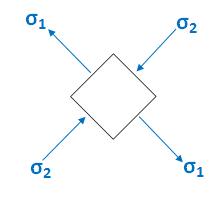
Note that there is no shear stress acting on the element at this orientation. When there is no shear stress interim on the element, the chemical element is called the "principal element", and the 2 stresses on the element and are known as the master stresses.


The objective of the Mohr'due south circle method is to find the orientation of the main element (i.e. , which for this simple instance was 45 degrees), and notice the values of and .
Finally - The method of Mohr'due south Cicle
Consider a square element that experiences the following stresses:
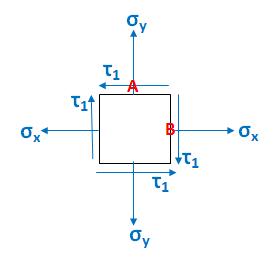
( = 0, in the examples previously shown )

At A:
=

= .

We take the shear stress every bit negative, because the shear stress at surface A tries to rotate the square element in an anticlockwise direction (near the center of the element). This is the full general convention used.
At B:
=
= (it causes a clockwise rotation - hence, it is positive)

Plot points A and B as shown below and draw a straight line across them:

Now draw a circle with a centre C and radius R, such that circle passes through points A and B equally shown below:

As you can come across from the diagram, C is the midpoint of A and B, hence its co-ordinate is calculated as: C =

Detect the correct angled triangle BC . Using Pythagoras' theorem, R can be calculated: = +


Besides, depict an angle of two , going from the line AB to the centrality. Notice that in this instance, this is a clockwise bending.
can be calculated through

Finally, the principal stresses and occur where the circle meets the -centrality. (Notice that these points have zero shear stress.)
From the diagram:
= C + R
= C - R
Finally, to transform into the coordinate system of the principal axes, rotate the original square chemical element by degrees clockwise (because you draw 2 as a clockwise angle in the above diagram):

Case [edit | edit source]
A rod is subjected to a tensile force and a torque, as shown below. Use Mohr's circle to work out the master stresses and describe the rotated square chemical element. (I recommend you endeavour this first before seeing the reply)

F = 2000N
T = 10 Nm
r = 0.005m
A (cross exclusive area) = kii

26,000,000 Pa = 26 MPa

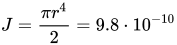
51 MPa


At A:


At B:


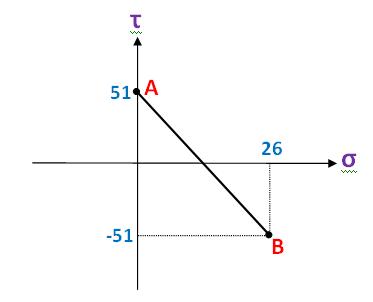
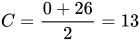
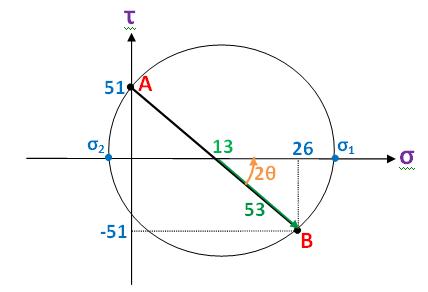





Detect that 66MPa is drawn equally a tensile stress (as is positive), and 40MPa as a compressive stress (every bit is negative)


That's it! If you take establish this article useful, please comment in the discussion department (at the peak of the page), as this will assistance me decide whether to write more articles like this. Too please comment if there are other topics you want covered, or yous would like something in this article to be written in more detail.
Back to the solid mechanics course
External Links [edit | edit source]
- Mohr's Circle Calculator
- Online Mohr's Circumvolve Calculator.
- Free Online Calculator for calculation of stresses on inclined plane and princpal stresses.

Source: https://en.wikiversity.org/wiki/Mohr%27s_circle
Posted by: mahoneycattess.blogspot.com
0 Response to "How To Draw A Mohr Circle"
Post a Comment